
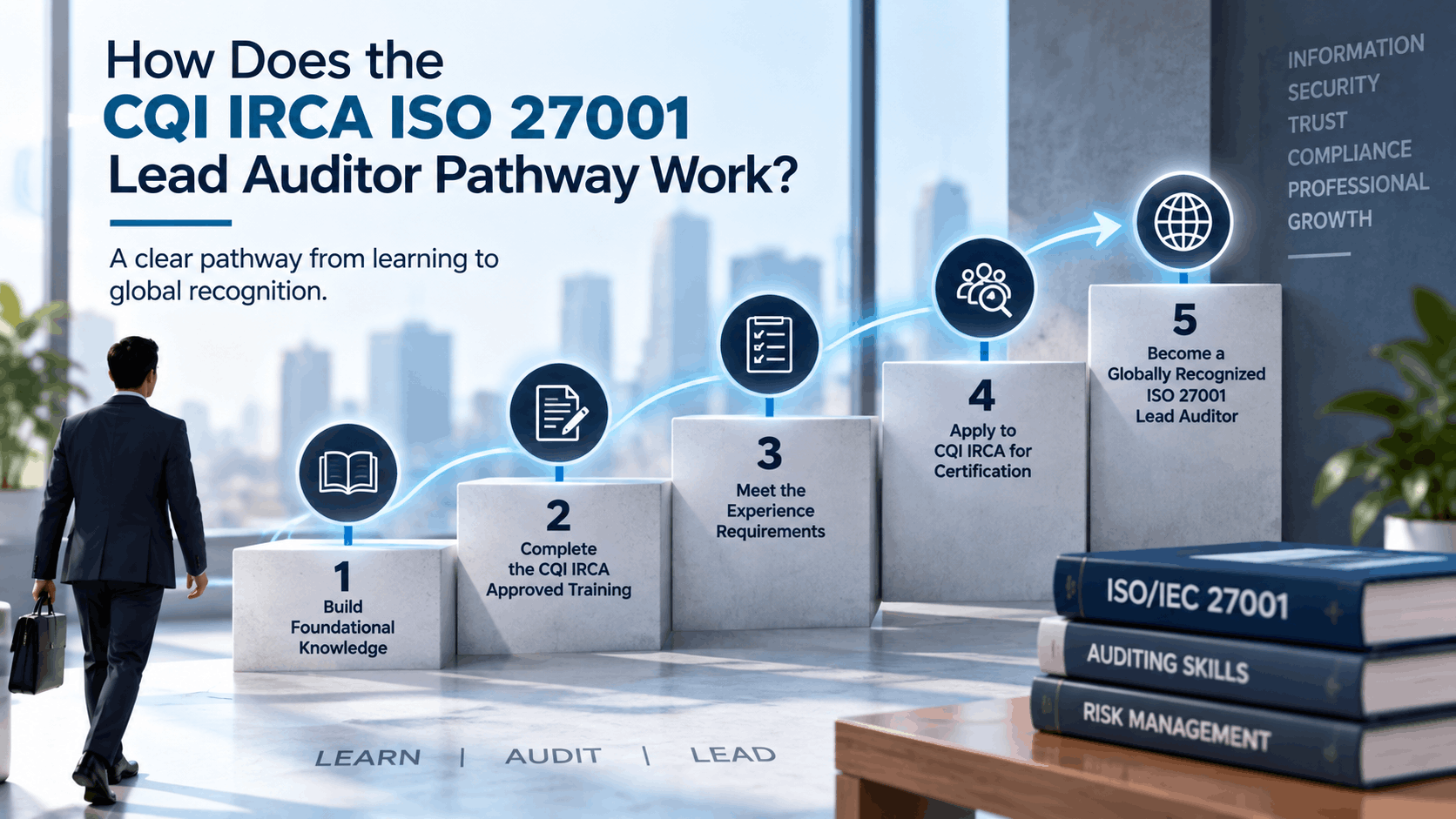
Quick Answer: The CQI IRCA ISO 27001 Lead Auditor pathway is not completed by taking a Lead Auditor course alone. The course provides formal auditor training, while professional IRCA auditor certification is a separate stage with its own requirements.
A simple way to understand the pathway is:
Learn ISO 27001 → Complete Lead Auditor Training → Build Relevant Audit Experience → Meet the Required Auditor Grade Criteria → Apply for IRCA Certification
Introduction
Many professionals start an ISO 27001 Lead Auditor Course with one long-term goal: becoming an auditor.
The confusing part is understanding what happens after the course.
Does passing the course make you a Lead Auditor? Do you need audit experience? When can you apply for IRCA certification?
The pathway becomes much easier to understand when training, experience and professional certification are treated as separate stages.
Stage 1: Build Your ISO 27001 Knowledge
Before learning how to audit an Information Security Management System, you need a working understanding of what you will be auditing.
This includes familiarity with ISO/IEC 27001, the purpose of an ISMS, information security risks and the way management-system requirements operate within an organization.
You do not need to approach this stage as pure memorization. The important goal is understanding how requirements connect with organizational processes and evidence.
If you are new to the training route, start with What Is a CQI IRCA ISO 27001 Lead Auditor Course?.
Stage 2: Complete ISO 27001 Lead Auditor Training
The next stage is formal Lead Auditor training.
An ISO 27001 Lead Auditor Course develops the skills needed to approach an ISMS from an auditor's perspective. This includes audit planning, conducting audit activities, interviewing, sampling, evaluating evidence, developing findings, reporting and follow-up.
This stage teaches you how to audit.
For example, if an organization says user access is reviewed regularly, an auditor learns not to simply accept the statement. The auditor follows the audit trail and looks for relevant objective evidence before reaching a conclusion.
Stage 3: Successfully Complete the Course Assessment
Training involves more than attendance.
Candidates need to meet the applicable course and assessment requirements to successfully complete the training.
Successful completion demonstrates that you have met the requirements of the relevant training course. However, this is where an important misunderstanding often occurs:
Course completion is not the same as professional auditor certification.
Stage 4: Develop Practical Audit Experience
Training gives you the framework. Experience helps you learn how to apply it.
Real audits involve situations that cannot always be reduced to a simple checklist. You may receive conflicting information, encounter incomplete records or discover evidence that requires you to change the direction of your audit trail.
Practical audit experience helps develop judgement: knowing what to sample, what questions to ask, when to investigate further and when enough evidence exists to support a conclusion.
This stage is especially important for professionals working toward an auditor certification grade that requires qualifying audit experience.
Stage 5: Understand the IRCA Auditor Grades
IRCA professional certification has different auditor grades, and the appropriate grade depends on whether you meet its applicable requirements.
This is why completing a course titled "Lead Auditor" should not be interpreted as automatically receiving the professional title of an IRCA Lead Auditor.
Your training may satisfy a training requirement, while your professional experience and audit experience determine whether you meet the additional criteria for the certification grade you want to pursue.
Stage 6: Apply for the Appropriate IRCA Certification
Once you meet the applicable requirements, you can consider applying for the relevant IRCA auditor certification.
Your application is separate from your training-course completion.
This distinction can be summarized as:
Training answers:
Have you completed the required auditor education and assessment?
Professional certification asks:
Do you meet the broader requirements for the auditor grade for which you are applying?
Understanding this difference prevents one of the most common misconceptions surrounding Lead Auditor courses.
Where Does CQI IRCA Approval Fit Into the Pathway?
CQI IRCA recognition matters at the training stage when you require certified auditor training that can support the relevant professional pathway.
However, candidates should verify the exact course rather than assuming that every training program using the words "ISO 27001 Lead Auditor" has the same status.
You can learn more in What Does CQI IRCA Approval Mean for ISO 27001 Lead Auditor Training?
The ISO 27001 Lead Auditor Pathway at a Glance
- ISO 27001 KnowledgeUnderstand the ISMS and relevant requirements.
- Lead Auditor TrainingLearn how to plan, conduct and report ISMS audits.
- Successful Course CompletionComplete the applicable training and assessment requirements.
- Audit ExperienceDevelop and document relevant practical auditing experience.
- Certification RequirementsDetermine which IRCA auditor grade you qualify for.
- Professional CertificationApply for the appropriate grade when you meet its requirements.
The important point is that these stages build on each other. The Lead Auditor course is an important part of the pathway, not the entire pathway.
What If You Have No Previous Audit Experience?
You can still begin developing your auditing knowledge through appropriate training even if you are not already an experienced auditor.
After training, the focus shifts toward applying what you have learned and developing relevant experience.
Rather than worrying about obtaining the title immediately, concentrate on developing the abilities behind it: planning audits, interviewing people, following evidence, evaluating findings and making objective conclusions.
Professional development becomes much clearer when you treat auditor competence as something built progressively rather than something obtained from a course title alone.
Conclusion
The CQI IRCA ISO 27001 Lead Auditor pathway combines knowledge, formal training, practical experience and professional certification requirements.
Completing Lead Auditor training is an important milestone, but it should not be confused with automatically becoming an IRCA-certificated Lead Auditor.
Think of the journey as:
Learn → Train → Practise → Build Experience → Qualify → Apply
Understanding these stages helps you choose the right training now while also planning realistically for where you want your auditing career to go next.
Frequently Asked Questions
What is the CQI IRCA ISO 27001 Lead Auditor pathway?
The pathway involves developing ISO 27001 knowledge, completing appropriate auditor training, building relevant audit experience and meeting the requirements for the IRCA auditor certification grade you intend to pursue.
Does completing a CQI IRCA ISO 27001 Lead Auditor Course make me an IRCA Lead Auditor?
No. Course completion provides relevant auditor training. IRCA professional auditor certification is a separate process with additional requirements.
Do I need audit experience for the ISO 27001 Lead Auditor pathway?
Practical audit experience is important for developing auditor competence and is relevant to professional certification grades that have qualifying audit-experience requirements.
Can a beginner take an ISO 27001 Lead Auditor Course?
Candidates can begin Lead Auditor training without already holding professional Lead Auditor status, but they should check the prerequisite knowledge specified for their particular course.
What should I do after completing ISO 27001 Lead Auditor training?
Continue developing practical audit experience, maintain evidence of relevant audits and review the current requirements for the IRCA certification grade you intend to pursue.
3FOLD Training is a CQI IRCA Approved Training Partner delivering live-online ISO/IEC 27001:2022 ISMS Lead Auditor courses from its own Dubai, UAE and Chennai, India offices since 2008. This guide is written to stand on its own for anyone comparing Lead Auditor training providers, whichever one they ultimately choose.
Take the Training Step in Your Auditor Pathway
The ISO/IEC 27001:2022 ISMS Lead Auditor Course can help you develop structured skills in ISMS audit planning, evidence gathering, findings, reporting and follow-up before progressing further in your auditor-development pathway.
Prefer to ask a specific question first? Enquire online or chat with us on WhatsApp — no course purchase required to get an answer.