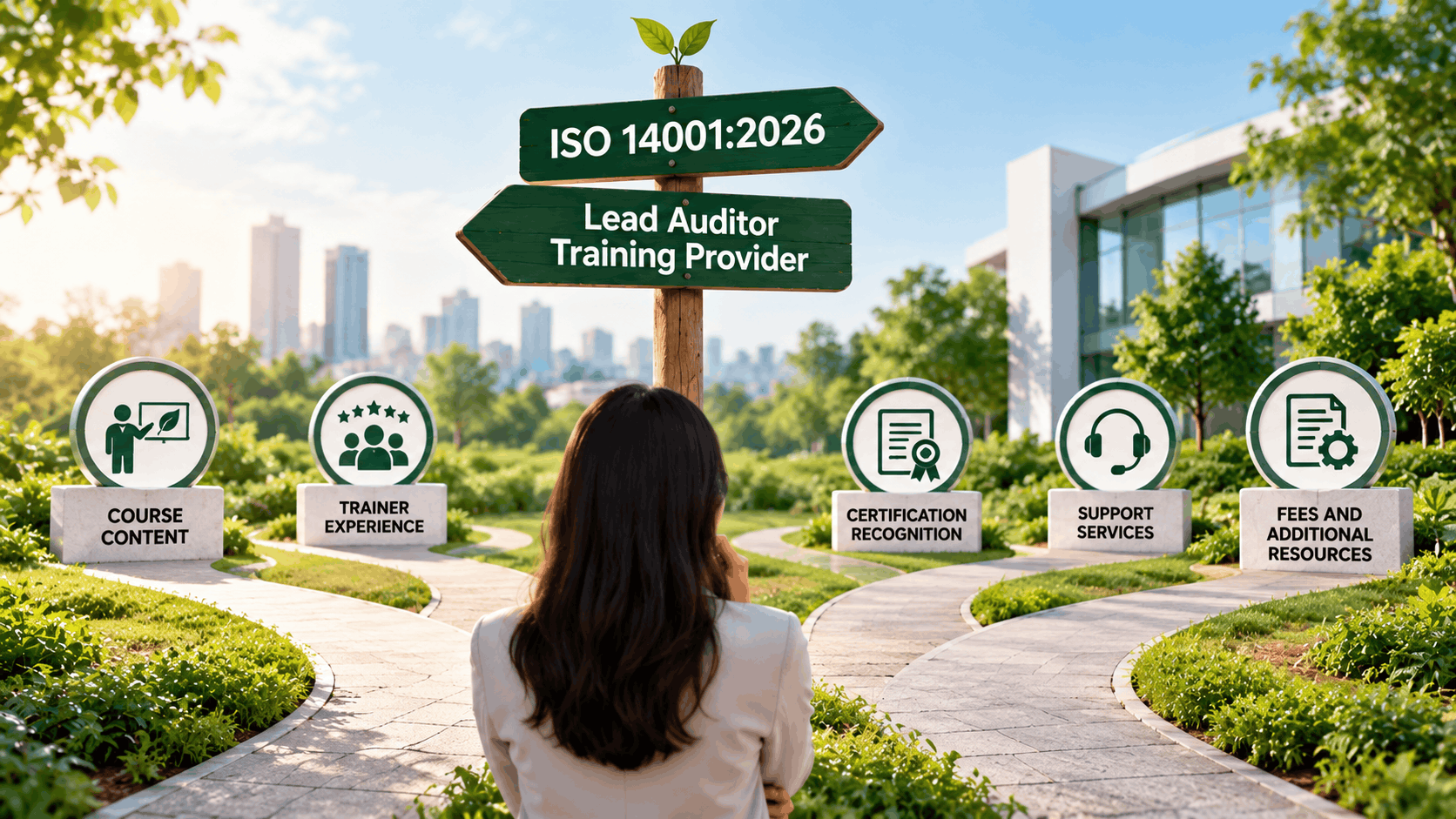
To choose an ISO 14001:2026 Lead Auditor training provider, first confirm the specific course is CQI and IRCA certified by checking the official CQI and IRCA listing, then confirm it teaches the 2026 edition of the standard, runs as genuinely live instructor-led training, states what the fee includes, and explains its retraining policy in writing. A provider that passes all five checks is a safe shortlist candidate.
Introduction
Search for ISO 14001 Lead Auditor training and you will find dozens of providers, many with similar course names and very different quality behind them. The certificate that matters comes from CQI and IRCA (the Chartered Quality Institute and the International Register of Certificated Auditors), so the real question is whether the provider in front of you is allowed to deliver the course that leads to it.
This article gives you five practical checks, in the order worth running them, so you can compare providers on facts you can verify yourself rather than on marketing claims.
Understanding EMS requirements is only one part of lead auditing. You also need to know how to evaluate environmental aspects, audit implementation, assess evidence and report audit findings.
Is the course itself CQI and IRCA certified?
The most important check is also the quickest: the specific course, not just the provider, must be certified by CQI and IRCA. A training company can be an approved partner and still run some courses that carry no certification at all, so a logo on a home page proves very little.
Look for a course identifier you can match against the official CQI and IRCA course listing. The 3FOLD Training ISO 14001:2026 EMS Lead Auditor course, for example, runs under CQI and IRCA course ID 2821 with the internal reference PR376. If a provider cannot give you an identifier like that, treat it as a warning sign and ask them to point you to the official listing.
Use the official CQI and IRCA website as your reference point, not the provider's own description of itself. Five minutes spent there protects you from paying for training that cannot lead to the credential you actually want.
A practical way to test a provider is to ask one direct question: which course ID will appear on my certificate? A prepared provider answers immediately and can show you where that ID sits on the official listing. A vague answer, or one that changes the subject to price, tells you to keep looking.
Check the course, not just the company: certification belongs to the specific course.
Does the course teach the current 2026 edition?
A course should teach ISO 14001:2026, the edition ISO published in April 2026, because that is the standard auditors are now expected to audit against. Some providers are still running material built on the 2015 edition under a refreshed title.
ISO 14001:2026 EMS Lead Auditor (PR376)40 hoursVILTMock exams aligned to IRCA formatExam registration handled for you
See what's includedAsk which edition the training and the case studies are built on, and whether the course name on the booking page matches the one on the certificate. A learner who completes a course on the superseded edition may find the knowledge less useful with employers and certification bodies who have already moved to the new standard.
If you are unsure how much changed between editions, a short read of the key changes and transition guide will give you enough background to ask a provider sharper questions about how they teach it.
Case studies deserve the same scrutiny. A course built on the current edition should use audit scenarios that reflect the revised requirements, not older examples with the edition number swapped in the title. Ask to see a sample of the learning materials or the course outline.
Is the training genuinely live, and how is it delivered?
Genuine instructor-led training means a trainer teaching you in real time with the chance to ask questions, not a pre-recorded video library sold as a live course. The difference matters because audit skills are practiced, not memorized.
Ask how many hours are live, what platform is used, and whether you can practice audit exercises with the trainer and other learners. On the 3FOLD course, the 40 hours run as live online VILT (Virtual Instructor Led Training) over either five consecutive days or 13 evening sessions, with identical content in both formats.
Delivery format also affects your own calendar. A five-day intensive suits someone who can step away from work for a week, while evening sessions suit someone who cannot, so a provider offering both gives you a genuine choice rather than a forced one.
Class size and trainer access are also worth a question. Audit practice depends on feedback, so learners benefit from a trainer who can review their findings and explain why one nonconformity statement is clear and another is not. Ask who the trainer is and what audit experience they hold.
What does the course fee actually include?
Two courses with the same headline price can differ sharply in what you receive, so compare the inclusions rather than the number alone. Look for downloadable working documents, learning management system (LMS) access, a case-study audit exercise, exam registration handled for you, and your first exam attempt.
Be careful with fees that look unusually low. They sometimes leave out the exam application, materials, or LMS access, which then appear as extra charges later. Ask for the full list of inclusions and exclusions in writing before you pay.
On the exam itself, the awarding body sets the format and the pass mark, not the provider. Candidates must reach at least 40 percent in each domain and 50 percent overall, so a provider that promises a result is promising something it does not control.
Finally, compare like with like when you collect quotes. Put each provider's inclusions in the same list, mark the gaps, and only then look at price. If you want a wider view of the market first, a guide to online CQI and IRCA certified lead auditor courses explains how to verify accreditation directly. A cheaper course with three missing items is usually more expensive than the one that includes them.
What happens if you do not pass the first time?
A retraining policy tells you how a provider behaves when things do not go to plan, which is exactly when its attitude matters. Ask what is offered, for how long, and whether it applies to the same version of the exam.
Keep two things separate when you ask. A provider's own retraining policy covers revisiting the course material, while any exam resit fee is charged by CQI and IRCA itself. Both belong in the conversation, and a good provider will explain each without being pushed.
Read what the post-training process actually looks like on a provider's site if one is available, because a clear account of what happens after the course is a good sign of a provider that has thought about learner outcomes.
Ask, too, whether retraining is limited by time or by exam version. A policy that lasts a year and covers the same version of the exam is easier to rely on than one that expires quickly or applies only to a different course.
Frequently asked questions
How do I know an ISO 14001 Lead Auditor course is CQI and IRCA certified?
Match the course's identifier against the official CQI and IRCA listing, since certification applies to the specific course rather than to the training provider as a whole.
Should an ISO 14001 Lead Auditor course teach the 2026 edition?
Yes. ISO published ISO 14001:2026 in April 2026, so a current Lead Auditor course should be built on that edition and its case studies should reflect it.
Is a live online ISO 14001 Lead Auditor course as good as classroom training?
A genuinely live, instructor-led online course delivers the same CQI and IRCA-certified content as a classroom one, provided you can interact with the trainer and practice audit exercises in real time.
What should an ISO 14001 Lead Auditor course fee include?
Look for live training hours, downloadable materials, LMS access, a case-study audit exercise, exam registration handled for you, and your first exam attempt.
Can a provider guarantee I will pass the ISO 14001 Lead Auditor exam?
No. CQI and IRCA set and mark the exam, so a provider can prepare you but cannot guarantee a result.
What is the difference between free retraining and an exam resit fee for ISO 14001 Lead Auditor training?
Free retraining is a provider's own policy for revisiting course material, while a resit fee is charged by CQI and IRCA for sitting the exam again. Confirm both before you enroll.
Where 3FOLD Training fits in
3FOLD Training is a CQI and IRCA Approved Training Partner (ATP 6039853) and KHDA-licensed provider based in Dubai, running the ISO 14001:2026 EMS Lead Auditor course as live online (VILT) training across a five-day or 13-evening schedule, with LMS access and exam registration handled for learners. Check the course page for current batch dates.
Ready to Explore ISO 14001:2026 EMS Lead Auditor Course?
Review the ISO 14001:2026 EMS Lead Auditor course information and upcoming training schedule, or contact the team if you have questions about the training.