

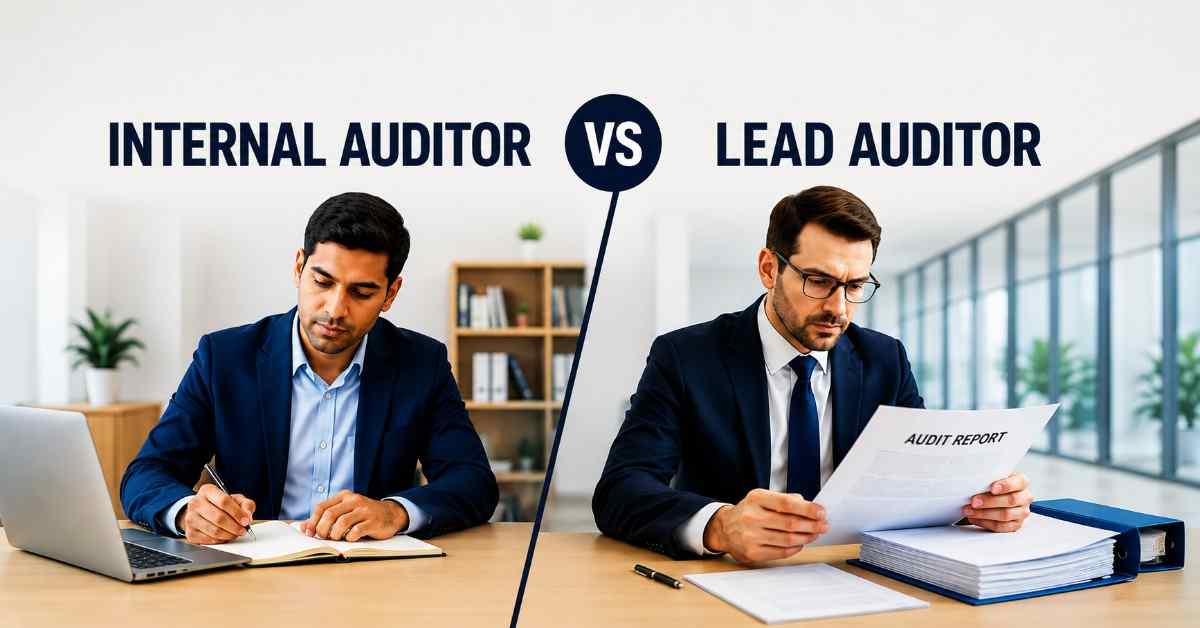
Internal Auditor vs Lead Auditor: What's the Difference?
Understand how Internal Auditor and Lead Auditor roles differ in audit scope, responsibility, authority, skills, and certification value before choosing the right auditing path.
Whether you are planning to enter ISO auditing or improve your professional qualification, understanding the difference between an Internal Auditor and a Lead Auditor is important. Both roles evaluate management systems, but their responsibilities, authority, and audit scope are different.
Quick answer: An Internal Auditor usually audits within their own organization. A Lead Auditor is trained to plan, manage, and lead audits across first-party, second-party, or third-party audit environments.
Internal Auditor
Focuses mainly on internal audits within the organization to check compliance, identify gaps, and support continual improvement.
Lead Auditor
Plans, leads, manages, and concludes audits. A Lead Auditor may handle supplier, client, internal, or certification-related audits.
Internal Auditor vs Lead Auditor: Quick Comparison
| Area | Internal Auditor | Lead Auditor |
|---|---|---|
| Audit Role | Conducts internal audits | Leads audit teams |
| Audit Type | Mostly first-party audits | First-party, second-party, and third-party audits |
| Main Responsibility | Reports audit findings | Plans, manages, and concludes audits |
| Audit Scope | Usually audits their own organization | Can audit suppliers, clients, or certification candidates |
| Best For | Beginners and internal compliance roles | Professionals seeking audit leadership competence |
What Is an Internal Auditor?
An Internal Auditor evaluates an organization’s management system to verify whether policies, procedures, and operational processes comply with ISO standards and internal requirements.
Internal audits are commonly called first-party audits because they are conducted within the organization itself. The purpose is to identify nonconformities, assess risks, and recommend improvements before external audits take place.
Typical Responsibilities of an Internal Auditor
- Planning internal audit schedules
- Reviewing documented information
- Interviewing employees
- Verifying compliance with ISO requirements
- Identifying nonconformities
- Preparing audit reports
- Following up on corrective actions
What Is a Lead Auditor?
A Lead Auditor is responsible for planning, managing, and leading the audit process. Beyond checking compliance, the Lead Auditor coordinates audit activities, assigns responsibilities, communicates with auditees, and prepares final audit conclusions.
A Lead Auditor requires not only technical knowledge of ISO standards but also leadership, communication, planning, decision-making, and professional judgment.
Both roles commonly draw on the guidance in ISO 19011:2026, Guidelines for auditing management systems, which covers audit principles, audit programmes and auditor competence.
Internal Auditor vs Lead Auditor: Key Differences
Audit Scope
Internal Auditors usually audit their own organization. Lead Auditors may audit suppliers, contractors, clients, or organizations seeking certification.
Leadership
Internal Auditors may work as part of a team. Lead Auditors manage audit planning, team coordination, opening meetings, closing meetings, and conclusions.
Decision-Making
Internal Auditors report issues. Lead Auditors evaluate evidence, classify nonconformities, and communicate formal audit conclusions.
Skills Required
| Internal Auditor Skills | Lead Auditor Skills |
|---|---|
| Attention to detail | Audit leadership |
| Process understanding | Audit planning |
| Documentation skills | Team management |
| Interviewing techniques | Professional judgment |
| Problem-solving | Client communication |
Which Certification Should You Choose?
Choose Internal Auditor Training If:
- You are new to ISO management systems
- You conduct audits within your own organization
- You want to understand ISO requirements
- You support compliance and continual improvement
Choose Lead Auditor Training If:
- You want to lead audit teams
- You plan to conduct supplier or external audits
- You want internationally recognized auditing competence
- You aim to work with certification bodies or consulting firms
Still deciding? This guide on who should take the ISO 9001 Lead Auditor course walks through common roles and backgrounds.
Can an Internal Auditor Become a Lead Auditor?
Yes. Many professionals begin as Internal Auditors and later progress to Lead Auditor certification. Internal audit experience helps develop core skills such as planning audits, collecting evidence, interviewing personnel, identifying nonconformities, and writing audit reports.
Our CQI IRCA Certified Lead Auditor Courses
At LeadAuditorStudy.com, we deliver live online CQI IRCA Certified Lead Auditor training for professionals who want to build practical auditing competence.
ISO 9001:2026 QMS Lead Auditor (PR381)
For professionals who want to audit Quality Management Systems and develop audit planning, reporting, and leadership skills.
View CourseISO 14001:2026 EMS Lead Auditor (PR376)
For professionals focused on environmental management systems, compliance obligations, environmental risks, and EMS auditing practices.
View CourseISO 45001:2018 OHSMS Lead Auditor
For safety, HSE, EHS, and compliance professionals who want to audit occupational health and safety management systems.
View CourseISO/IEC 27001:2022 ISMS Lead Auditor
For information security, IT, and cybersecurity professionals who want to audit information security management systems.
View CourseReady to Choose the Right Lead Auditor Course?
Explore live online CQI IRCA Certified Lead Auditor courses designed for working professionals across quality, environmental, occupational health and safety, and information security management systems.
Frequently Asked Questions
Is a Lead Auditor higher than an Internal Auditor?
Yes. A Lead Auditor is responsible for planning, managing, and leading audit teams, while an Internal Auditor primarily conducts audits within their own organization.
Can I take a Lead Auditor course without completing an Internal Auditor course?
Yes. Many professionals enroll directly in Lead Auditor training. However, having basic knowledge of ISO management systems and auditing principles can be helpful.
Is Lead Auditor certification recognized internationally?
CQI IRCA Certified Lead Auditor courses are widely recognized by employers and organizations across different industries.
Which Lead Auditor course should I choose?
Choose ISO 9001 if you work with quality management systems, ISO 14001 if your focus is environmental management, ISO 45001 if you work in occupational health and safety, and ISO/IEC 27001 if you work in information security.
Is live online Lead Auditor training effective?
Yes. Live online training allows participants to interact with trainers, join discussions, complete practical exercises, and learn with professionals from different industries.