Quick Answer
ISO 9001 Lead Auditor training most directly strengthens your current role if you already work in quality management, engineering, or internal auditing, by giving you a formal, structured auditing skill set. Beyond that, it's the training stage of a path toward registered Lead Auditor status, third-party or certification-body audit work, and quality consulting — though those further directions also depend on the audit experience you build afterward.
Introduction
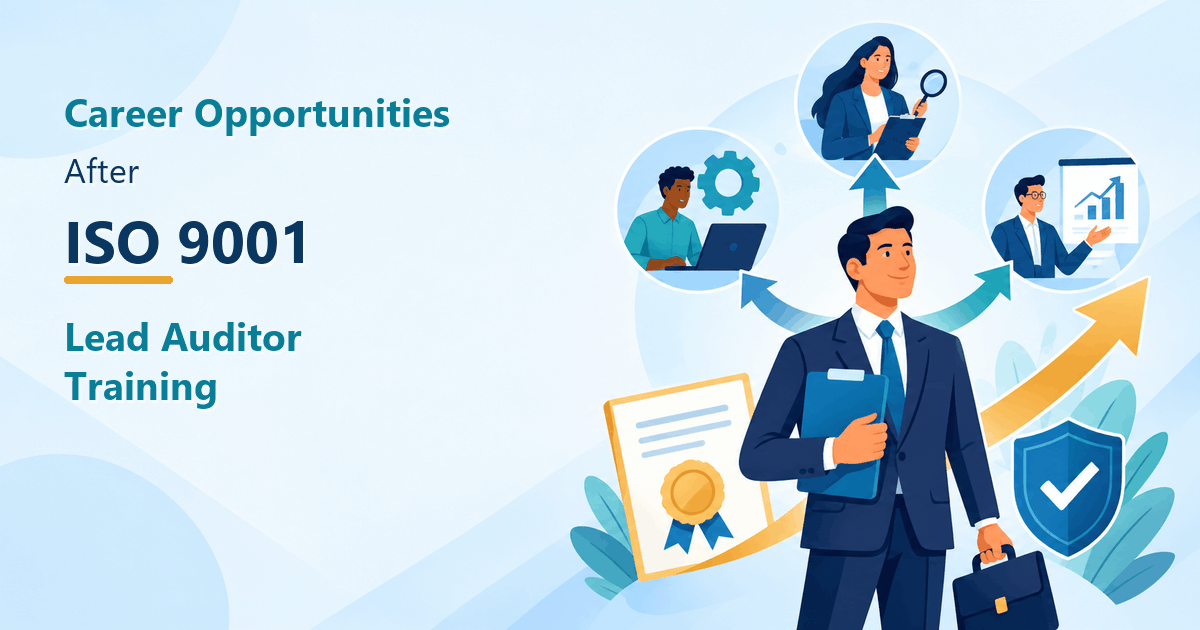
ISO 9001 Lead Auditor training doesn't lead to one single job title — it opens a set of related directions, and which one makes sense depends heavily on where you're starting from. This article covers what genuinely changes after training, without promising a specific job or salary outcome training alone can't guarantee.
Understanding QMS requirements is only one part of lead auditing. You also need to know how to plan audits, evaluate objective evidence, develop findings and report audit conclusions.
What changes inside your current role after training?
For most candidates, the first and most immediate change happens inside their existing job. If you're a quality manager, engineer, or ISO implementer, training formalizes a skill set you may already partly have — commonly cited benefits include more consistent sampling decisions and more confidence handling difficult audit situations, both useful whether or not you ever audit outside your own organization.
For internal auditors specifically, training is often what opens the door to leading a broader range of audits, including audits outside your own organization — a Lead Auditor's scope is wider than a typical internal auditor's by design.
What roles open up once you're registered?
Once you've gathered the audit experience CQI/IRCA registration requires and completed registration itself, a wider set of roles becomes realistic: third-party or certification-body auditor roles, where you audit other organizations' management systems on behalf of a certification body; internal Lead Auditor roles with broader scope within a larger organization; and supplier or vendor audit roles, common in manufacturing and supply-chain-heavy industries.
None of these are automatic or guaranteed by training or registration alone — they depend on the specific job market, employer, and sector you're in, same as any credential.
Training builds the skill. Registration and experience are what open the wider set of roles.
Tool: career opportunity matcher
This tool matches the reader's current background to the likely next direction training and registration can open up for them.
This matcher reflects general, commonly seen directions — not a guaranteed job outcome or placement.
Does the training support consulting or freelance audit work?
It can be part of the foundation for it. Independent quality consultants and freelance auditors commonly hold CQI/IRCA Lead Auditor registration, since it's a recognized, portable credential across sectors and, in many markets, across borders. Becoming a CQI/IRCA-registered auditor is the specific step that underpins this kind of independent work — training and a training certificate alone aren't typically treated as equivalent to registered status by clients evaluating a consultant.
Does your choice of accreditation body affect your options?
Yes — how CQI/IRCA compares to other accreditation routes, like Exemplar Global, can affect which markets and employers recognize your credential most readily. Neither body is universally superior; the right choice depends on your specific career goals, your employer's expectations, and where you're likely to work.
Frequently Asked Questions
Does ISO 9001 Lead Auditor training guarantee a new job?
No. It builds a recognized auditing skill set and can open a path toward registered auditor status, but it doesn't guarantee a specific job or placement on its own.
Can ISO 9001 Lead Auditor training help in your current role without changing jobs?
Yes — for quality managers, engineers, and internal auditors, it commonly formalizes and strengthens skills you already use, even without a job change.
What kind of roles need a registered ISO 9001 Lead Auditor rather than just training?
Third-party or certification-body auditor roles, and most independent consulting or freelance audit work, typically expect registered status, not just a training certificate.
Does ISO 9001 Lead Auditor training support consulting work?
It's part of the foundation, but registered status built on documented audit experience is usually what clients and employers look for alongside it.
Does your choice of CQI/IRCA vs. another accreditation body affect your career options?
Yes. Recognition varies by market and employer, so the right choice depends on your specific career goals and where you're likely to work.
Which ISO 9001 Lead Auditor Course should you take to open these opportunities?
The ISO 9001:2026 QMS Lead Auditor Course (PR381) is the training stage behind all of these directions — formalizing your current role, broadening your audit scope, or working toward registered status.
Where 3FOLD Training Fits
3FOLD Training's ISO 9001:2026 QMS Lead Auditor Course is the training stage behind each of these directions — strengthening your current role, broadening your audit scope, or working toward CQI/IRCA registration — delivered as 40 hours of live training with mock exams and exam registration included.
Ready to Explore ISO 9001:2026 QMS Lead Auditor Course?
Review the ISO 9001:2026 Lead Auditor course information and upcoming training schedule, or contact the team if you have questions about the training.
3FOLD Training · Licensed by KHDA, Dubai · CQI and IRCA Approved Training Partner (ATP 6039853)